The Alden Graveyard

High on a hill above the Taunton River in the south section of Bridgewater, Massachusetts sits the tiny, 19th century Alden Graveyard. It also goes by the name of Great Woods Graveyard, which I suspect was a name given in later times, although the name pays homage to the tall, straight white pine trees that were harvested over time for use in the region’s boat-building industry. (The graveyard’s earliest identification on Plymouth County deed transfers had it simply as a “burial lot”.) The graveyard is surrounded by a low, lichen-textured, New England-style stone wall, the kind that was constructed with “two-handers” (boulders that required two hands to carry.) The graveyard had a single, u-shaped carriage drive that would deposit “attendees” at the door of the centrally located Alden tomb. 

The high perch where the graveyard sits is surrounded on three sides by rolling, terraced fields. We knew it as “Titicut Hill”, but there was also a brief and casual reference to another name — “Hill of Sorrow” — because a sachem’s daughter was murdered there, so Mom once claimed. I grew up next to the Alden Graveyard. The lot of land upon which our little home sat was owned in the early 1800’s by the Deacon Asael and his wife Sarah (Alden) Shaw. It was either Sarah’s two brothers — Solomon and Amasa — or, more likely, her father, Solomon, who — along with his son, Amasa — donated one acre of bordering land in the late 1700s for use as a “burying lot”. 

It pains me to admit how much time my siblings and I spent playing among the headstones and upon the central tomb (and — as a fitting punishment — knee-deep in poison ivy that naturally loved the stone walls). If you stood on top of the earth-covered tomb, which in appearance resembled a hobbit home, and faced southwest, you had a sweeping view of rolling, terraced fields.* Beyond the fields, you could see the silvery thread of the Taunton River. Ok, so I want to believe that, but it’s a lie that I had so thoroughly convinced myself of. Bob — and my four other brothers — assure me that you couldn’t see the Taunton.**  It suggests that the forest was working at its own regeneration, spreading outward from the banks to reclaim what it had lost in the prior centuries. 

It can be expected that colonial era graveyards — with their utter lack of adornment — don’t excite interest beyond the occasional visitor. Visitors who, like me, enjoy musing about the somber and strenuous lives of 18th and 19thcentury New Englanders. They’re quiet, reflective places. That is, unless you’re a young girl who allows herself to be talked into entering the tomb. I will never forget the day I foolishly stepped into that dark, dank, silent space. There had to have been an insanely attractive reward offered by one of my brothers. Most likely Chris. I do recall descending at least one or two of the granite steps. (That must have been one of the conditions for my reward.) The heavy metal door was pulled shut and I was alone in the tomb, or “alone” only in the sense that I was the sole breathing person in a room that also housed dead bodies. I pounded and screamed for hours. Once again, that part is untrue. I think I pounded and screamed for five seconds. . . which seemed an interminably long time.

When the fields on the far side of the graveyard were covered with snow, the whole Alden Square neighborhood took to toboggans and skis and saucers and Flexible Flyers for hours of outdoor sledding. Alternatively, and when we needed a more immediate rush, we’d dash over to the graveyard; from the tomb’s summit, we’d either roll our bodies down (doable at any time of year) or — when snow cover allowed — steer our sleds along a twisting path, avoiding (as best we could) the headstones, much as skiers do on alpine courses. Like, very short courses. . . maybe 15-meter. (For those readers who are at this moment cringing, I promise that, as an adult, I’m much more respectful. . . and not as idiotic where it concerns personal safety, but I doubt your thought process ventured so far as to reflect on the hazards to personal well-being.)

For me, it wasn’t all about play, however. I came to know the families who slept quietly there, and would read and re-read the inscriptions and epitaphs. The earliest known owners of our home made that graveyard their final resting place. The Deacon Asael Shaw is truly “rest[ing] from his labors”, having lived to the surprising age of 92. And “resting place” really does have fulsome meaning, for 18th and 19th century folk believed that admission through the pearly gates could only be secured by presentation of a notarized form vouching for a life of hard work, sacrifice, misery, and really plain and uncomfortable “waring appearill”. (I love to insert that expression whenever possible.) 

My fascination with graveyards, as you can imagine, has been a natural outgrowth from having been next-door neighbor to the bones and spirits of colonial era yeomen and the like. I intend to continue cultivating my interest when opportunity permits — if you’ve ever driven with me, you’ll no doubt have seen my head pivot when I spot a tiny graveyard. I only occasionally, however, will respond to the tug to stop and walk around. Maybe it’s because of the residual sense of terror it inspires — what if someone were to shut me in another tomb? Or, maybe it’s because I am too fearful of the day that my own flesh will mingle with the dust. I don’t want to rush things.

~

*By the way, it didn’t pay to take in the north view from Titicut Hill. All those red-brick buildings with bars covering the windows were a disturbing reminder that ours was generally known to the rest of the town as the “prison neighborhood”.

** Bob, bless his little heart, allows me to save face by qualifying his statement; it was possible that one could see the flood waters that would occasionally breach the banks and travel as far as the pigeon coops.

Scarlet Fever — A Persistent Worry

Part of this story concerns a topic that has been gently brewing in my mind for over two years. It was given a toe nudge by recent reporting about the proliferation (globally) of cases of scarlet fever.

I wouldn’t have been able to tell you what “iGAS” stands for until a couple weeks ago when I came across an online Wired article that seeks to draw attention to the disturbing uptick in scarlet fever cases. (“The UK Is Enduring an Onslaught of Scarlet Fever. Is the US Next?”) The article itself links to the Center for Disease Control and Prevention’s website, where you read a simple message and try not to hyperventilate: “Increase in invasive Group A Strep infections.” Short in length, the message goes on to warn, “iGAS infections include necrotizing fasciitis and streptococcal toxic shock syndrome.” It is highly contagious, and often fatal. Sometimes the bacterial toxins associated with the infection move so fast that by the time the sufferer seeks medical relief (in the form of antibiotics), it’s too late. Very scary stuff. I find myself reflecting uncomfortably on those occasions as a child when I suffered with strep throat, but, jeesh, these new bacterial strains are a whole ‘nother thing.

The Wired article presents both a historical view of scarlet fever, even looping in old familiar stories in which the disease afflicts beloved characters (Beth March of Little WomenMary Ingalls in the Little House series, also Boy of The Velveteen Rabbit), as well as the disease’s latter-day machinations. Making much of the fact that scarlet fever never went away, its gradual scaling up the last decade or so (in number of documented cases worldwide) is cause for concern.

It is equally concerning that there’s no systematic method of documentation, nor any reliable means to share. Here in the United States, only ten states participate in a “surveillance” program run by the CDC. (See “Active Bacterial Core Surveillance.”) Further limiting the program’s reach and effectiveness is the fact that unless the person stricken with illness is admitted to a hospital, the data is not collected. 

The obvious controversy is that data collection may be seen to infringe on individual privacy rights. That’s a legitimate worry. How, then, do we discern trends and patterns, a contagion’s migratory behaviors, and still preserve our rights to privacy? On a micro level, when a doctor (or a nurse) enters into a patient’s chart their diagnosis, along with the list of patient symptoms, in my mind, a breach has already occurred, regardless of how “trusting” the relationship may be that a patient has with their physician. . . and nurses. . . and technicians. . . and front-end staff. . . and — gosh — any hackers who might illegally access patient records. I imagine that if a patient had an objection to their doctor’s inputting of data — weight, height, blood pressure, complaints, diagnosis, whether they feel safe at home — they probably wouldn’t even be visiting the doctor’s office in the first place. No clinician would agree, either, to see a patient who won’t allow data to be gathered. Is there a way, then, that relevant data (surrounding contagions) can be harnessed by a central databank without violating personal privacy? Not surprisingly, I haven’t any answers.

Invisible Killers of the 19th Century

Eliza (Buswell) Coffin must have gasped in horror when one of her children came to her complaining of a sore throat that first week of January back in 1863. It was less about the throat than the angry rash on eight-year-old Caleb’s skin that gave flight to her blossoming dread. At the time, her husband, Samuel Coffin — the well-known boatbuilder of Rings Island — was off doing his part to save the Union in Baton Rouge, Louisiana. (He would endure his own private anguish a couple months later when his younger brother with whom he had enlisted — John — died there of “congestive chills”, likely malaria.) In a matter of two weeks, Eliza stood helplessly by as one by one three of her five children died, all from scarlet fever.

Mid-19th century was, of course, still a time of antiquated thinking, at least in terms of people’s understanding of human health; in particular, their understanding of disease. Louis Pasteur’s “Germ Theory” was just beginning to excite curiosity among the medical establishment, but any observable progress wouldn’t happen for several decades. And antibiotics, the miracle treatment, wouldn’t become available until the 1940’s. Thus, when one looks at town reporting of deaths from that time, it might startle to see how many people died of bacterial diseases, such as diphtheria, consumption, typhus, dysentery, scarlet fever, chronic diarrhea, and cholera (and — with similar symptoms affecting only young children — cholera infantum). Of course, there’s the occasional “dropped on his head” mention, but from our enlightened 21st century perch, we’re left to wonder why it took so long for scientists to draw the connection between illness and “invasive bodies” that can only be detected by means of a microscope (something that had been invented at least as early as the 1600’s.) So little did doctors understand the causes behind illness that they naturally made judgments based entirely on symptoms. “Cause of death”, therefore, always must be treated with a grain of salt when perusing death records from throughout the 19th century. (Perhaps not as baffling was the lengthy delay on the part of the public to accept scientific wisdom; we need look no further than our own communities today to witness the skepticism with which new scientific findings are treated. Because we are unable, for example, to see how all the recent variants of the COVID virus are spreading, mutating, and jumping species, many of us remain unconvinced of their lethality, even their very presence.)

I admit to a morbid fascination with death. Plagues and poxes unnerve me, but they do also electrify my curiosity. When I do my genealogical research, I can find plenty to capture my interest just by reading death certificates. One great-great-grandfather, Patrick McKenna, whose peripatetic journey took him from County Monaghan, Ireland to the textile mills of Glasgow, Scotland, then to various mill cities of New England; survived into his 70’s after decades of factory employment. (Spotty record, that one had — he couldn’t manage to hold onto any job for long. Rather a tragic figure.) It appears he died at the Tewksbury Almshouse, with cause of death determined to be “pthisis”, aka consumption, more commonly known these days as tuberculosis. Another great-great-grandfather, James Loughnane, died much younger (in his 30’s) from — yet again — consumption. He, too, had been a mill worker whose (short) life story read a lot like Patrick’s. 

The Buswells of Mudnock Road

Closer to home — literally — my interest at the moment has turned to Eliza (Buswell) Coffin because of a study I freely undertook a couple years ago on a house that I see from several windows of my own home. I’m not a creepy stalker, but my interest was instantly sparked when I heard someone make passing reference to an ancient intra-family feud, simultaneously gesturing toward the “William Buswell” home. (Actually, one of two “William Buswell” homes that sit only yards apart on Mudnock Road.)

If you stand on Mudnock Road at the top of (and facing) Niko Way, the home that sits on the right corner, at 34 Mudnock Road, is the newer Buswell home, built in 1780. (Its twin was built 50 years earlier and gives the appearance of having been more loved — or at least cared for — through the years.) The “newer” Buswell home stands on the original 2-acre homestead lot of Isaac Buswell (laid out in 1639 as part of the First Division of Settlers). The federal-style “double house” has a brick wall running right down the center of it that serves as a physical signpost of the acrimonious relationship that developed between two brothers, Walker and Jacob Buswell, soon after the hammers and saws ceased their racket. (It is quite possible that Walker was the one to erect the dividing wall, as, in addition to being a yeoman/farmer, he was a bricklayer.)

“Deacon John” Buswell, seven years before he died in 1783, thought he was doing a good deed. He had ample personal property and real estate holdings, but lots of children — nine, in fact. (The Buswells appear to have been prolific reproducers.) He outlined carefully in his will who should inherit what. His language was clear: along with his lot of marsh in the meadow and half of this and half of that lot (he really did have a finger in every pie), Walker should have the “easterly part of my homestead. . . my shoemaker’s shop. . . and my hog house.” To Jacob, The Deacon bequeathed the westerly side of the homestead and his (other) dwelling house, as well as the other half of this and the other half of that lot.

It has been my opinion — after reading and re-reading his document — that, as careful and thorough as The Deacon had been, as aware as he was of his own substantial holdings, he misjudged the character of the two sons who were expected to “play nice together” and share. For over thirty years, the two brothers occupied the home, Walker and his family on the east end, Jacob and his family on the west end. They both lived into their 80’s; Walker died in 1817, Jacob in 1822. The record provides us with no evidence that fraternal harmony ultimately prevailed. Going forward, the language of their titled properties became complex and is clear about “passing” and “re-passing” rights where it concerns access to the well, the barn, the shoe shop, etc. Meanwhile, their brother Caleb — jauntily sporting the “wearing appearill” left to him by Dad — went merrily about his way, tending the Chester, New Hampshire farm bequeathed to him (and raising a brood of ten — all sons).

Walker, for all the headaches that co-ownership posed, inexplicably died intestate. . . and with debt to be settled. His interest in the easterly half of the home was bought out at auction by his 20-year-old grandson, John Walker Buswell. Then, in 1825, John Walker paid Caleb Pike Jr. $700 for property that included the westerly side of the house; the home, going forward, would be known as the “J.W. Buswell Home”. In that way, any embryonic references to the “Otis Pike Home” became moot.

Eliza was one of five girls born to John Walker and Nancy (Walton) Buswell, their fifth child (of eight.) Her choice of husband was likely based on sound reasoning. After all, the Coffins of Rings Island were solid people. Long-time ship builders in a ship-building village. There were lots of Coffins on Rings Island. The Mudnock Road Buswells — yeomen, mostly — were, likewise, solid people. There were lots of Buswells on Mudnock Road. The union of the two powerhouse families held great promise.

Epidemics, with their seemingly mysterious origins and movements, have beleaguered and bewildered communities since time immemorial. It should be here noted, however, that 1863 was an especially bad year for Salisbury in terms of mortality. The number of deaths — 89 — was more than double the deaths recorded the year before for our small town. Thirty-seven of the reported deaths (or 42%) were of children and infants (ages 0-17). Of that number, seven were victims of scarlet fever. As noted, three of the seven were Eliza and Samuel’s small children.

It is a belief held by some that families of earlier times became so accustomed to the beckoning finger of the grim reaper that they were inclined to adopt a dispassionate attitude toward death. If you read epitaphs from headstones for children who died in the 1800’s, you come away with a different perspective. While “heavy clod” and “arms of God” seem fitting for someone who died in their 86th year, and “mouldering bones” is perhaps apt for any adult who has passed on, the epitaphs for children are much more touching expressions that suggest real grief, even foundering defenselessness against baffling forces. As one example, in the Great Woods Cemetery in Bridgewater, next to the house I grew up in, one of the epitaphs for a child who died at age 6 reads: “Nature has but soft powerful bands, And reason she controls; While children with their little hands, Hang closest to our souls.” We see, then, that as much as 19th century New England families looked to their bibles for consolation and guidance, they grieved just as deeply as we do now upon the death of a loved one, especially a child.*

~

For two years the imagined grief of Eliza (Buswell) Coffin has resided as a slow simmer in the back of my mind. All the while (and after) I researched the Buswell home, the nearness of which reminds me of a mute, doddering forebear; I’ve wondered how she weathered her crisis in 1863. After losing three of their five children, Eliza and Samuel had two more. In one way or another, all the descendants wove their lives into the fabric of the river- and ocean-side communities of Rings Island and Newburyport. Thus, it’s impossible in current times to uncouple the Coffin name from the history of Rings Island.** 

After a bit of searching, I was able to discover a photo of Eliza. As much as I had been hoping to see an image of her as a young woman, this one, at least, is a close-up — a good one, at that — so one is able to see fine details.*** In the photo, which appears in a direct descendant’s published history (The Coffin Family of Rings Island by Cynthia C. Wildes, great-granddaughter of Eliza and Samuel), Eliza is an old woman. She appears to be looking slightly up and to the left of the camera; it causes her to have a far-away look. The lines on her face read like a city map, and I wonder if they’re caused by a vigorous life of hard work (outdoors?), or from a lifetime of internalizing painful experiences. Her white hair, vaguely wavy, is center-parted and carefully but simply coifed, tucked behind her ears and fastened snuggly. She appears serene and self-contained, but also exudes confidence — she is sure of her place in this world. Do I detect, though, a hint of sadness in her expression? Perhaps. Or, perhaps, I should read it simply as weariness. I decide to tuck this mental image in a quiet corner of my memory. I want to remember Eliza (Buswell) Coffin, even though I never met her — she was, after all, born nearly two hundred years ago, and lived in an era that persists in confounding me, try as I might to make sense of it. I want to remember her because of the connection I have made between her childhood home and the home I own, which, once upon a time, was part of the Buswell homestead lot. It’s more than conceivable that her little feet scampered across the same yard that is now my yard. Like most people who are interested in the past, I seek the common elements that bind me to events and people who lived before.

~

*One way that mothers could express their sense of loss was by keeping close to their heart (in an ornamental locket) a tuft of hair snipped from their departed child. Another common practice from Victorian times that today we view with curiosity (maybe even unease) was the fashioning of jewelry out of hair, and not necessarily from a dead person; just as often from a good (living-breathing) friend. In a National Geographic article by Becky Little, “Trendy Victorian-Era Jewelry Was Made From Hair”, Karen Bachman of the Morbid Anatomy Museum in Brooklyn, NY puts it this way, “Women of the 19th century would swap locks of hair as a love token the way young girls today might wear friendship bracelets.” The hair could be fashioned into earrings or pendants. The popularity of “hair art” owes to its enduring qualities — hair takes a long time to decay — and because, as Bachman points out, “it’s a very personal indicator of self.” 

~

**Lincoln Coffin, born in 1864, will make a cameo appearance in a separate story, one that caused a surprised “Oh!” in my research of the long-time residence of the Salisbury Historical Society on Second Street. (Keep an eye out for that as a future blog post.)

~

***I had been trying to secure permission to include the image as part of this story, but determining the person or concern that currently holds the copyright is a frustrating exercise.
Corner Elm, School and Mudnock — A Brief History

This essay is probably only of interest to my fellow Salisbury citizens. . . and maybe a smattering of other people who like small town history.

Here’s an interesting question that many will quickly answer (but, as confident as you may be, you’ll be wrong): What restaurant chain — ubiquitous in New England along its most traveled roads — became known for its 28 flavors of ice cream and its color palette of white, turquoise blue, and orange; and boasted a large windmill at its entrance

If you answered “Howard Johnson’s”, you wouldn’t be far from the mark because Howard Johnson had bought out nearly the entire chain by 1940. “Dutchland Farms” dairy stores (using only Grade A milk for their ice cream) and restaurants began popping up on our “highways” in the late 1920’s. They were the brainchild of Fred Forest Field, a dairy farmer and shoe manufacturer of Brockton, Massachusetts. 

While I hesitate to say that Field had just the right amount of privilege to be able to engage in risky ventures with utter insouciance, he did manage to live comfortably and had a supportive family (especially his older brother Daniel, who brought him on as a partner in at least one of his shoe factories.) Fred’s father ran a large and successful dairy farm, for which Fred drove a milk wagon as one of his earliest jobs. No doubt it was while he was engaged in this work that his energetic imagination took flight with the future possibilities. And much later, while out motoring one day in 1912 in West Falmouth, Massachusetts — not too far from his summer home at Monument Beach, he came upon a Dutch windmill, and determined to buy it. The windmill had been constructed over 100 years earlier by Dutch settlers, so its pedigree provided assurance that it would endure. It didn’t hurt that a one-ton stone mill came with the package, and Fred intended to put it to use grinding corn on his family farm — Dutchland Farms — in the Montello section of Brockton, Massachusetts.

Why I suggest that Fred Field had great imagination is because he could envision in those early days of automobiles a need for accessible pit stops, first for ice cream and farm and dairy products, and (soon after) for simple lunch fare.  It was a natural way to expand on the profitability of his already lucrative dairy farm. The first Dutchland Farms ice cream stands began to appear in 1928, and by 1933, there were at least 50 roadside stands in the region. 

In Salisbury, construction began in early 1933 at the juncture of Elm Street, School Street, and Mudnock Road — right where our public library stands. At that point in time, the unimproved property belonged to Frank V. Brown of Newburyport. (Brown, who was married to Jacob F. Spalding’s daughter Louise, ran the Brown Jewelry Co. in Newburyport for several decades.) The dairy store and ice cream stand in Salisbury would boast the Dutchland Farms name and would be managed by Fred Kennedy of Natick. Brown entered into an indenture agreement with Kennedy in January of 1933, leasing the land to him for four years (with the option to make improvements to the land and erect a business for the purpose of selling dairy products; Kennedy also was given the option to buy out Brown in exchange for $4,000.)

Kennedy never did exercise his right to buy the land. While the property remained in the Brown name until the 1950’s, the various victualers who enticed hungry motorists to their restaurants at that location present a steady and diverse stream of business models. Fred Lupus engaged in extensive repairs in 1936, opening his “Dairy Kitchen” in the spring of that year. By the mid-1940’s, however, management had shifted once again, this time to the business duo of Nicholas DeLuka of Medford and Peter A. Rais, WW2 veteran of Somerville. DeLuka and Rais had worked together in the restaurant business before the war; they called their business the Sheraton Farm Restaurant, continuing fountain service while also enticing hungry travelers with “choice and good dinners”. 

Fred Field’s Dutchland Farms franchise stumbled badly during the Depression, while its most direct competitor —Howard Johnson — was able to steer a steady course through the trying times. By 1940, all the Dutchland Farms restaurants had either closed or been purchased by a proprietor, with the remainder being acquired by Howard Johnson. As part of the arrangement, Howard Johnson appropriated the white, blue, and orange color scheme and the “28 flavors of ice cream”, but Field’s emotional attachment to the windmill that was commonly used as a roof or entry feature must have been well-known within the family, for his son (or whoever was at the helm in 1940 — Fred Sr. had passed away in 1934) refused to allow Johnson to use it for his Howard Johnson restaurants.

Back in Salisbury, meanwhile, the building at the juncture of Elm, School, and Mudnock continued to be occupied by restaurateurs. Briefly, it was The Rainbow Restaurant, run by Earle Sanders. The grand opening, from June 30 – July 5, 1950, hoped to entice patrons by advertising “inspired cooking” by Jim Bevins, “noted chef from the North Shore.” (Newburyport Daily News, June 30, 1950) (Earle and Paul Sanders, brothers, could trace a direct line back to an early settler of Salisbury, John Sanders. As an interesting aside, the saltbox that stands at 1 Mudnock Rd. returned to the family in 2004, after a 352-year absence. The original owner, John Sanders, sold it in 1652. It would take the indefatigable enthusiasm and tenacity of 12th generation direct descendent Paul to bring this happy occasion about.) 

In the spring of 1952, aggressive renovation once again preceded the opening of a new restaurant, “Stromberg’s, Famous for Sea Foods”. The name would have been instantly recognized by those who were familiar with Frank Stromberg’s other restaurant in Salem “at the Beverly Bridge”. Stromberg didn’t just own the business and the building; he held the deed to the land — the first time in 30 years that the land had passed hands. After only two years, however, Stromberg closed the seafood restaurant and sold the building and its contents to a Mr. Charles Hobbs — who proceeded to remove everything off the lot. Stromberg sold the corner lot itself to the Town of Salisbury. Had he found the competition too formidable among the restaurants in the area who likewise offered seafood? Browsing a June edition of the Newburyport Daily News, one sees advertisements for Marston’s at the High Road bridge in Newburyport (a restaurant that originally was a dance hall with vaudeville shows; in 1952 patrons could either take out or dine in), the Lighthouse Grill on Plum Island Point (specializing in clams and seafood, and offering fountain service, as well), The Beachcomber on P.I. Turnpike (the best clams in Essex County, you could order pie, too!), Stonie’s (at the airport); and in Salisbury itself, Clarke’s Seafood (right on Bridge Rd.) and the Little Red Barn (a restaurant serving southern bbq fare, but where you could also order a lobster roll). 

Did it chaff, too, that a Howard Johnson restaurant sat smug and righteous just up the street at the Seabrook circle (where the Town Hall now stands)? Perhaps not. The Dutchland Farms name had by this point in time largely receded in memory — even if each successive restaurant’s grand opening at the corner of Elm, School, and Mudnock made nostalgic references to their earliest forebear. To appreciate how starkly different the trajectories were for Fred Field’s Dutchland Farms and Howard Johnson, by 1952 there were 355 Howard Johnson restaurants ranging along the eastern seaboard. With ambitious plans to expand westward — the early 1950’s encompassed a hopeful era for those wishing to capitalize on the explosion of American mobility — Howard Johnson boasted that they sold more fried clams and hotdogs than any other restaurant chain. (Newburyport Daily News, Sep. 29, 1952)

1954 represented a pivotal moment for the one-acre lot at the corner of Elm, School, and Mudnock. There would be no more restaurants. Instead, the Town had designs for a new library. Initially (in 1954), voters rejected at Town Meeting a proposal to buy the lot and build a new library. A re-worded proposal the following year narrowed the focus: voters were subsequently asked to support the Town purchasing the lot. . . with the ultimate aim to build a new library. Baby steps, I wager, made for a more palatable statement of vision. In June, 1956, ground was broken for the new library. 

And three decades later, the library needs of the Town were once again of great concern.  Dedicated space for meetings, quiet study areas, and general building upgrades became the fuel for battle cries, and so trustees engaged in a prolonged campaign. It would take until May of 2013 for voters to approve a $7.4 million project, half of the funds being promised through state grants. The beautiful building that now stands at the corner of Elm, School, and Mudnock makes a proud statement. It takes effort — at least to this perennial Salisbury neophyte — to imagine an era when cars filled with family would pull up and park, kids spilling out and galloping headlong through the doors to satisfy ferocious hunger pains. . . right at that very same site.  

Fred Field may not have lived long enough to know that his franchise would flounder irrevocably. Such would be a blessing. He wasn’t wrong, though, in his understanding of human nature. The automobile — as soon as it became an attainable acquisition for the average person — resulted in wave upon wave of migratory behavior. It’s hard to say why none of the restaurants managed to fare well in that location. Perhaps the most logical explanation is that the area became too quickly saturated with restaurants competing for hungry customers. 

*********************************

Sources:

Newburyport Daily News (Archives)

(https://en.wikipedia.org/wiki/Dutchland_Farms)

Boston Evening Transcript, 16 Oct 1912

(https://restaurant-ingthroughhistory.com/2012/12/05/famous-in-its-day-dutchland-farms/)

Pantry Thief

I want to say I’m ten or eleven years old, but, no, it’s 1969 and I’m thirteen years old. I should know better, but I give in to temptation nevertheless. I’ve hopped onto our washing machine, careful not to let my bare toes “clunk” into its frontside. Crouching-standing on top of the washing machine, I reach with my right hand to push aside the line of forward-facing common dwellers, solid-feeling containers of flour and neglected items long past their ”use by” date. They stand sentry on the top shelf, alert now, positioned to conceal the treasure sitting somewhere behind. Unseeing, my expectant fingers caper across one or two unfamiliar shapes before encountering the familiar smooth surface — my brain’s pleasure center lights up. With both hands now cradling my prize, I sit back down on the washing machine and quietly lift the cover on the bakery box. I’m smug in the knowledge that I have found it before anyone else. I’m sure others have already searched. 

Aunt Ginny’s wedding was yesterday, thus bringing to conclusion a well-seasoned (decades-long) engagement. Jimmy’s a sweetheart, and we don’t mind adding “Uncle” to his name. My three older brothers and I stood stiff and awkward in our “best attire”, clothing that hung on us as uncomfortably as hair shirts. It wasn’t just the clothing — we don’t do formal very well. Give us rolling fields, ponds to swim in or skate on, sunshine, and fresh air. Especially, give Kevin hard-packed lanes across those fields so he can race a car — better still, if pursued by patrol cars supplied by the nearby prison. Let us brawl. But dressy and solemn are not our jam. 

We spectated in silence through the church ceremony, standing when others stood, kneeling, too, genuflecting just a beat late, yet casual enough to suggest we do it all the time. I cried in the church. I was thinking about my younger (and only) sister, Margaret, who should have been there — she had a new dress, too, but she was in a hospital (trying to remember who she was and who she belonged to, after a really bad car accident). We maintained our silent observation throughout the reception, bewildered by the tender father-daughter dance. Our grandfather, whom we all call “Gama” (rhymeswithllama), is still in deep grief, adrift alone. His Anastasia, our Nana, died last year. 

We all noticed the white bakery box that came home with us. No discussion. We are all in silent competition. Bakery boxes never come into our house. With no thought to dignify the act with fork or plate, I dip my fingers into the delicious cake. Inches of creamy and smooth white frosting give way to moist cake. My fingers — rapacious little grubbers — clutch mounds of cake and frosting. I shove the sweet, spongy confection in my mouth in helpless desperation. It’s as good as I had hoped. And well worth any punishment by Dad — or expressions of disappointment by Mom — when I’m found out. Wary of being discovered, I replace the cover and return the bakery box to the high shelf, arranging for its concealment once more. I will see you later, I promise, as I leap to the pantry floor.

Opinion: What’s the Matter With You, Charles Koch?

Charles G. Koch, the long-reigning CEO of Koch Industries, has shown his avaricious nature by publicly stating recently that — by continuing business operations in Russia amidst the barbaric war that their leader is waging against Ukraine — he is putting the welfare of 600+ employees ahead of the greater cause of democracy and the lives of thousands of innocent Ukrainians. (By the way, Mr. Koch, no one believes that that’s the fundamental reason for your inaction. Profit has always been your prime motivation. How else to explain that you’re the 18th richest person in the United States — right behind your brother’s wife, Julia Koch.) I’m taking specific aim at Koch Industries when I condemn the 162 companies that obstinately refuse to end or suspend operations in Russia.

Why does Charles Koch deserve particular scrutiny or scorn in this instance? While it’s convenient to begin with his self-delusional lie regarding his reasons not to suspend business in Russia, there are more worrisome signs, in my mind, that this individual is devoid of most of the characteristics that I associate with worthy, civic-minded Americans. And while he may be a decent human being — he looks like he is kindly, his ideologies are in perfect contrast with my own.

The list of sins is long:

  • Deems labor unions as harmful to workers.
  • Minimum wage, likewise, hurts workers.
  • believes public education has been contaminated by a culture of “protectionism”. I listened to a podcast in which he spoke with authority about the common practice of school districts to keep unqualified teachers, all harking back to the poisonous effect of teacher unions.
  • Public educators stifle creativity and promote liberal views.
  • Believes there should be broad environmental de-regulation.
  • Is skeptical about climate change, especially our species’ role in it.
  • A free market economy fosters a society where the rich will provide for the poor; we don’t need governmental assistance (or interference), thankyouverymuch.

Any one of his “truths” can easily be dismantled, and as a retired educator with years and years of both classroom and leadership experience, I’d love to go toe-to-toe with him — at least on the matter of public education; but at the end of the day, his bottomless wallet has vastly more influence on others’ thinking than my impassioned words. He can set up nonprofit organizations, and as part of his family’s “Youth Entrepreneur” program he can dangle tuition money and start-up money in front of (literally) hungry and directionless students; he can even transfer jaw-dropping amounts of money into Republican candidates’ coffers or lobby for de-regulation in all manner of industry.

With the bits that I’ve learned about one of our country’s richest individuals — and I admit a certain bias against ridiculously wealthy people; they can’t claim to have a genuine pulse on what’s best for the average man or woman— I can’t help but shake my head in pure disbelief when I contemplate Mr. Koch’s indefensible contention that he cares too deeply about his 600+ employees working in glass manufactories (operations for which Koch Industries receives tax credits) within the borders of one of our world’s most thuggish and megalomaniacal dictators. Charles Koch’s “philanthropic” reputation cannot help but be stained by his decision. It is to be hoped that he will see the light. . . before it’s too late.

Sources:

Bridges

As everyone who knows me understands, I love to study the landscape when driving. It takes a real conscious effort to keep my eyes on the road, and there are several views that make such responsible behavior very difficult. As I’ve mentioned before, whenever I cross the Gillis Bridge on Rt. 1 between Salisbury and Newburyport — especially at either sunrise or sunset — my eyes veer from the path I’m traveling in order to drink in the beauty. What is it about bridges that stirs our sensibilities?

When I was teenager (and at the age where one would assume reason had begun to take hold), I often took long walks and even longer bike rides from my home high on Titicut Hill, a place that had amazing, long views in nearly every direction, but was envied by no one because of its proximity to a maximum security prison. For those wondering why on earth I would take long walks and bike rides in that setting, it comes down to this: you can live a cowed, circumscribed life behind locked doors, or you can shrug your shoulders and ask yourself, what are the odds — really — that an escaped prisoner will happen to be in the same space at the same moment as I? (Weirdly, and maybe inexplicably, I didn’t find it creepy, but rather reassuring when the patrol would follow slowly behind me on the service roads and field lanes.) As everyone who grew up around Alden Square knows, you did your best to assign the prison to a subordinate corner of your mind, and tried to have an ordinary childhood.

In my travels back then I would inevitably stop in the middle of whatever bridge I crossed. Living in Bridgewater implied that there was no paucity of bridges that spanned waterways. Most often, the water maundered lazily, affording my thoughts to likewise flow without hurry from one idea to another. Whether this habit translated into a lifelong fascination with bridges over water, or it was because of an innate fascination in the first place that led me — as if by magnetic force — to the middle spot of all those hometown bridges; it has been an enduring compulsion.

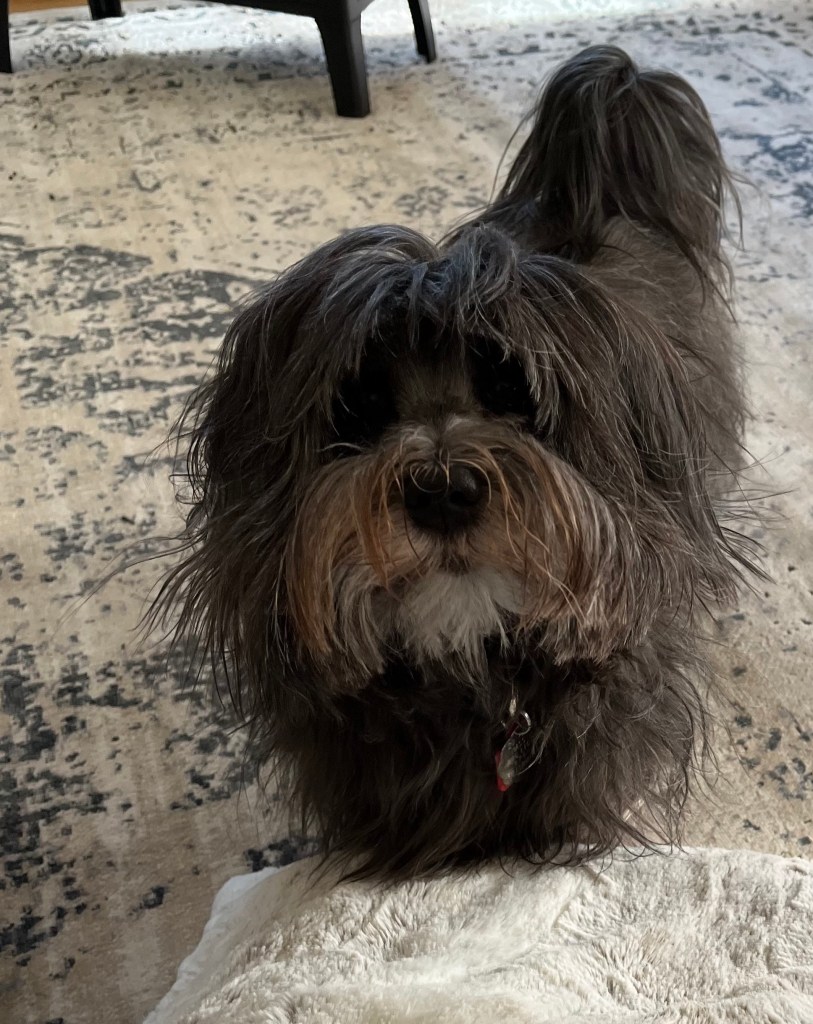
My dog Mona, however, does not share my affinity for bridges, and I trace it back to our first “journey” over a serious bridge. Soon after the completion of the new John Greenleaf Whittier Bridge over the Merrimack River in 2017, I was eager to walk the pedestrian trail connector that was included in the engineering plans for the replacement bridge. (The bike/pedestrian walkway had been proudly acclaimed as the first of its kind to be built into an interstate bridge.)

After parking the car, I set out with Mona from the Salisbury side of the William Lloyd Garrison Trail. We had gone barely fifty feet and she began sniffing around for a suitable place to “do her business”. Alas, her only option consisted of one thing — concrete. Soon her appraisal took on a desperate quality. I assumed (wrongly) as I coaxed her along that she would become less particular about bathroom accommodations. She tried to be a good sport about it, trotting along for a bit, then swiveling or zigzagging whenever her nose picked up a scent that only dogs can detect. Dissatisfied, she’d then continue on beside me. By now, we were about one-third of the way in our ascension of the bridge’s span. And, then, Mona’s relief was suddenly at hand (or paw). There, right there in her path, was the magic key to her deliverance. A single leaf. I watched — one can’t help but be interested when a dog is aiming for a single leaf. Mona skillfully arranged herself above the leaf and achieved a perfect dispatch. (Granted, the havanese — with those short legs — is already close to the ground.) I may have imagined it, but it did seem her eyes rolled toward heaven and she shuddered with (physical) relief.

Mona seemed, if not happy, at least willing to continue our journey. I, of course, felt the need to reach the pinnacle of the bridge’s span. (For those unfamiliar with the Whittier Bridge, it is a substantial one over a sizable river.) If I could get to the bridge’s midpoint, I knew I would be rewarded with an exquisite view of Deer Island, which sits in the middle of the Merrimack, suspended charmingly between two small bridges. To this point, I hadn’t noticed that the wind was picking up. But, by the time we reached my goal and turned to face Deer Island to the east, the wind was howling. I wanted to enjoy the moment. I tried to enjoy it. I just couldn’t, and in all fairness to my 12-pound little girl, the situation demanded that I — for once — accept that not every bridge is well-suited to reflective thought. We turned and headed back down the bridge, Mona in good spirits, but — no doubt — making a mental note to object with every one of her twelve pounds if I ever, ever tried to take her on the Whittier Bridge again.

Merrimack River looking west from RR Bridge trailhead at Old Eastern Marsh Trail (Salisbury MA)

My Introduction to Dough

I set out recently to learn a new skill. I’ve never been able to work with dough, not the gratifying kind that earns interest. . . well, maybe that, too, but rather the sticky goop that insists on shrinking when you manhandle it with a rolling pin and yell at it to expand. As if in a cruel twist of irony, all the other necessary ingredients and supplies that you remove from your cabinets do very much appear to swell to eventually consume the entire expanse of your kitchen island, as well as all remaining open counter space. (I never concern myself with the rogue bits of cheese and diced vegetables that descend to the floor, as the dogs will work conscientiously to address that issue.)

My husband George was the pizza expert in our house, having acquired mastery in the years he worked (as a high school senior and then while a student at North Shore Community College) at Monty’s Restaurant in Lynn (of the “Monty’s Monty’s by the sea, buy two pizzas get one free” renown.) Over the years he perfected his own recipe, very similar to the thin-crust sort that Monty’s sold. We were all big fans of his style of pizza. Sadly, he never wrote down the recipe, nor did he share it orally with any of us.

This past Christmas Eve, my older daughter and I joined our McKenna relations in Beverly and had a relaxed dinner featuring pizza with crust that very much resembled George’s, nice and thin and crispy. I consider it close enough to say that it is. . . well, close enough, so I have an acceptable contender for the crust. I’m still working on what goes on top of that, as well as my skills in making it look round and even.

Not content to satisfactorily make just pizza, I got it in my head that I wanted to learn how to make English muffins. I blame it on Judy, because she came to one of our “girls’ breakfasts out” with bags of homemade english muffins for each of us. Darn it, but weren’t they the most delicious?! That was at least a year ago, and now that I’m working on my dough skills with serious purpose, I decided this past weekend to make some myself. “So easy”, “the simplest recipe”, “a snap”, “a cinch” — such lies those culinary bloggers boldly (and cheerily) posted. Maybe my first mistake was consulting people who spend their days in their own home test kitchens. It would have been more helpful to land on a blog in which the blogger admitted frankly that they don’t know what the f**** they’re doing in the kitchen. It would serve as a vital object lesson for all other amateurs (and by “amateur” I mean a total ignoramus).

If you saw the resultant state of my kitchen (both days, since you are advised to “proof” it overnight and do a second proof on day 2), you would be struck by how uncannily similar it appeared to the Ardennes Forest in the Battle of the Bulge. Every surface staggered under the weight and chaos of bowls, skillets, whisk, sheet pans, spatulas, flour, cornmeal, more flour, more cornmeal, small bowl for milk (that I failed to warm up), additional bowls (because “medium-size” is such a relative term), melted butter (because I was too aggressive with the microwave), specks of yeast (because those packets are impossible to open neatly), cooling rack, and all manner of measuring utensils. But not, significantly, a metric weight scale. I won’t go into the specifics and tease out where I first went wrong (and where I subsequently went wrong), but I will say that despite sensing at nearly every stage that I should scrap the mission, I persevered. . . nevertheless.

Lacking the highly desirable nooks and crannies, and denser than the expected “light and fluffy” quality, and not so much round as asymmetrical and somewhat oval and of varying sizes, they have — in the end — a mild and satisfying flavor. I’ll take it! If George were here, I think he’d applaud my efforts. He’d probably gush — as he poured syrup all over them — about how delicious my pancakes are, and I wouldn’t feel the least need to disabuse him!

My Version of U.S. Route 1

My introduction to Route 1 was arranged by my new boyfriend in the spring of 1976. With a meticulously detailed, hand-drawn map, complete with images of cows in front of Hilltop Steak House (Saugus) and the impressively tall and long stone wall bordering Parkland Avenue (and Pine Grove Cemetery) in Lynn , I nervously set out one Saturday morning. It’s doubtful that I had ever driven further north than Randolph, Massachusetts, and the soundness of my 1963 Rambler was always a concern. Granted, it was a solid piece of machinery and would likely have plowed over most other vehicles on the road — that is, unless the engine seized or I blew a tire, my greatest worries of the day. I pretty much stuck fast to that same course whenever I visited George or his dad from parts both south and north of there. In all the intervening years — 1976 to now — whenever I travel that path I think about that map, especially the cows and that imposing wall. It might have been one of the earliest signs that this guy was really into me.

Until I later moved with this boyfriend-cum-husband-cum-father-of-my-children to Salisbury in 1985, my feelings about Route 1 were clear and, frankly, immutable — I hated it. Drivers were the worst! None of the three lanes was safer or saner than the others. It wasn’t until I had a few travel experiences on Route 128 that I would cease to announce (to anyone who cared), “Route 1 is the worst road ever!” It’s even worse today, hardly shocking news.

U.S. Route 1 in Byfield, MA

But there’s another stretch of Route 1 that I came to know after we moved to Salisbury, and it’s a much friendlier, more soothing segment for the motorist. In fact, the section between Danvers and Salisbury — where it’s a single lane in either direction — in no way resembles the nightmarish part between Boston and Danvers. For those who reach that part alive, you’re graced with bucolic roadside scenery. The traffic lights in that stretch, given as gentle reminders to keep your speed moderate, have the added advantage of coaxing a pleasant examination of the surroundings. You can, as well, more easily contemplate the road’s origins.

If you’ve ever wondered about the naming of our roadways, your curiosity should begin with, why U.S. Route 1? Of all the numbered roads, being #1 is bound to be important. It may not be necessary to begin at the very beginning, when it was a mere trail system for travelers on foot, then horse-drawn cart, then stage coach. My own curiosity forms a halo around the persistence of the “Newburyport Turnpike” name. The turnpike era began in the final years of the 18th century, coinciding with a blossoming national sentience. With our struggles for independence a settled matter (by and large), our confidence as a new nation permitted us to turn our efforts toward long-term projects. With products being zipped all over and between the states, a tipping point had been reached; municipalities were finding it difficult to make improvements and regular repairs to public roadways. It does seem hard to fathom that once upon a time, road maintenance was 100% a local responsibility. (Think about that every time you pay a toll going over the Tobin Bridge or use the Mass. Turnpike.) Public charters, arrangements made between municipalities and private companies, acquired a decided appeal. And, even though their margin of profit ebbed and flowed in season with the rise and fall of other modes of popular transport, they can be credited with our roads’ finest hour in terms of maintenance. (Again, think about that each time your car hits a pothole.)

Returning to the naming of our roadways, before a consistent numbering convention was drafted in 1925, all the major roads bore names that reflected their uniqueness, as it were. But the states were suffocating beneath the ever-growing confusion of road names, not to mention the increasing traffic as Americans indulged their new passion. At that time, road names were much more evocative: the Dixie Highway, The Yellowstone Trail, and — of course — our own East Coast Highway, to which everyone along The Atlantic seaboard wanted to belong.

The really interesting piece in all of this is how the U.S. Department of Agriculture — in particular, its Bureau of Public Roads division — formalized the exact trajectory of the course that came to be called U.S. Route 1. I’d always assumed that the pathway that bears the name Route 1 was an obvious delineation, easily traced in red on an early 20th century Rand McNally road atlas, but with the clamoring interest up and down the Atlantic coast to be included, a definitive means of codifying needed to be established. There was instant approval of the idea advanced by E.W. James, chief of design for the BPR, that they use the historic “Falls Line” roadway network as a template. In the early days of our nation when cargo was moved by boat, communities were established as far upriver from The Atlantic as boats could safely reach, usually at the point where they encountered falls or rapids. To meet overland cargo transportation needs, a network of inter-city roads was established. Anomalies, inconsistencies and political outmaneuvering notwithstanding, that’s exactly the pathway that U.S. Route 1 followed, beginning in 1926.

Parker River at Rt. 1 (looking west), Newbury MA

For all the years that I traveled back and forth to my teaching job at Triton High School in Byfield, Massachusetts, I never took for granted my commute along Rt. 1. I always rhapsodized about how easy and relaxing it was. Even though it would have been faster to take Route 95, I nearly always opted to go the slower road. For those of you thinking, Gawd, who would choose willingly that nightmare of a road? I point out that Rt. 1 between Danvers and Salisbury is a delightful departure from parts both south and north of there. In Topsfield, the way is bordered by old stone walls, behind which can be seen rolling meadows and antique farmhouses. Postcard worthy images, for sure. Further north (and part of my daily path), the marshland through which the Parker River flows was a constant source of pleasure, especially early in the morning. Each day, by the time I crested the hill above the Parker, I opened my mind to the anticipated landscape. Often, the mist was just beginning to dissipate, exposing the salt marsh hay stacks above a fleecy blanket of white-gray. Other times the mist traced a serpentine path directly above the river. And there were plenty of mornings, too, when the long shadows cast by the rising sun distorted all the features before me, creating a surreal canvas of darks melting into lights. No matter the season, there was joy in the scenery. With only three traffic lights between my house and school, and few cars on the road so early, I was pretty much alone with my thoughts for the twelve minute ride to work. Given how easily I was distracted by the landscape, it’s remarkable that I never crashed into anything. I was probably most at risk when I knew the sun would just be edging above the horizon as I crossed the Merrimack — I could never resist craning my neck at precisely the mid-point of the bridge. And I always always remarked — to no one other than myself — about how beautiful it was.

early morning, crossing the Merrimack River, October 2015

Inasmuch as I might entertain a sentimental wish that we could return to a more intimate era when our major roadways sported names that reflected regional character, such an invocation to revisit the past can provoke unpleasant consequences. Who, really, would think it wise — or sensitive — to reintroduce and perpetuate, for example, a highway that contains the word “dixie”, given the word’s association with a romanticized antebellum era? My wistful thinking is modulated further when I consider that the earliest (successful) efforts to name our “trails” were outcomes of merely the noisiest promoters of road names. It wasn’t any governmental body that affixed the names to our major roads up through the early decades of the 20th century. It was trail associations (with very defined motivations) who often competed for naming rights, and who — in fits of pique — might change the course of their routes and completely snub offending cities, making it all be known by slapping up new signage on barns, rocks, trees, or other visible objects. Say what you will about governmental interference, but the national systematizing of our roadways was an inarguable giant step forward. The fact that anyone can reasonably navigate from one part of the country to another is largely due to the imposition of a systematic and simple strategy — north-south routes were given odd numbers, east-west even numbers (with the more substantial transcontinental routes being further categorized: east-west were two-digits ending in zero, and north-south ending in either one or five.) Think of any numbered route and apply this formula — it works!

It is my great hope that you — loyal readers — don’t get overly mired in the nomenclature, and instead aim your car for destinations that provide ample roadside distractions. Even before I was retired and traveled the same 12 miles to work each day, I never ceased to be surprised by the landscape along Route 1. I’d like to think that roads aren’t empty, colorless lanes between point A and point B, but rather conduits to experience nature’s ever-shifting kaleidoscope of images. It’s worth it to leave for work just a few minutes earlier in order to luxuriate in the details that we’re forced to overlook when it’s a frenzied commute down the interstate. I’d like to think that for over twenty years I took a Sunday drive — every work day — so that I wouldn’t miss out on the blanketing mist that hovered over the Parker River flood plain or the occasional Northern Harrier who glided above it or the sun rising over the Merrimack, all images that bolstered me, centered me, imbuing each day with meaning and purpose. Such memories I hope to always hold dear.

Spectator Par Excellence

From the moment I could toddle without great risk of thumping my head on objects in my path, Mom’s unvarying instructions to my older brothers before they hurtled out the door for all manner of improvised adventure was always, “Watch your little sister, please.”

“Sure, Mom,” was their standard reply, never breaking stride and never glancing back, but assuming — accurately — that I would tail them wherever they went. Whether I have a right to be, I am reassured in my belief that they took that responsibility seriously, and would never let harm come to me. At least that’s what I say now. As a child, I was pretty skeptical that they were in full accord with the mantra of “leave no soldier behind”.

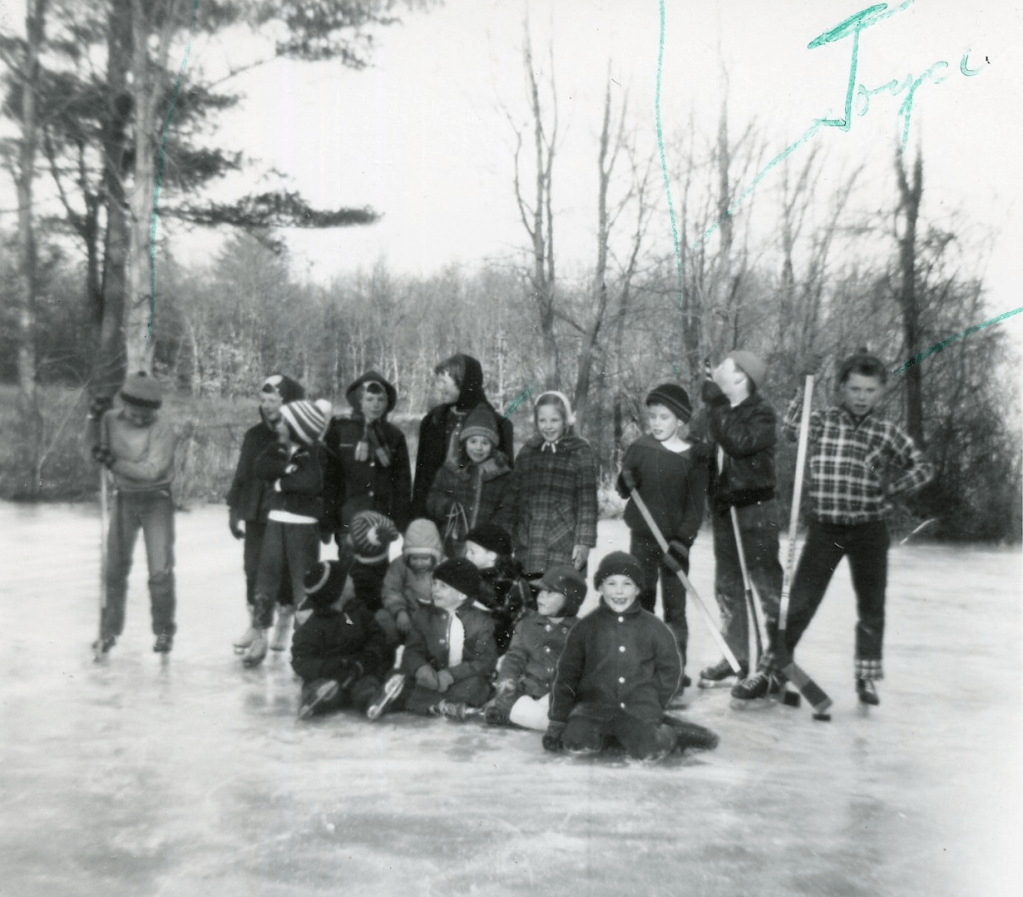
Gildea cousins at the First Pond (Papa Joe’s birthday, 9-Feb 1965)

Behind our grandparents’ farmhouse at 1777 South Street were three small ponds tucked into a wooded area.  They were imaginatively named “The First Pond”, “The Second Pond”, and “The Third Pond”. Rarely were they ideal for skating because the surface would be covered with leaves, twigs and branches, or snow. For early efforts at learning to ice skate, however, they should have been perfect. There were frozen streams, too, that connected the three ponds, allowing you to conveniently skate from one to the next. I was forever pursuing my older brothers, who, without warning, would all race off to the next pond. I think I cried a lot when they did that; without their reassuring nearness, scary woodland creatures could easily pick me off. As I watched their receding figures cut a swift and serpentine path away from me, I couldn’t help but contrast their elegance with my own on-ice conduct. Where their movements were fluid — there’s undeniable and exquisite beauty in skating (especially on those long stretches of straight-away where the arms and legs form a harmony of sweeps and arcs as one’s stride lengthens) —all I managed to do was walk around gingerly, tentatively, objecting to the foreignness of my figure skates. With crooked ankles nearly grazing the ice and arms akimbo, mine was a style that forced my body to either do splits every eight feet or so, or go horizontal to land flat on my back, whereupon I lay motionless and studied the undulating tips of the trees stroking the sky directly above me.  One can only hold that position for a few minutes before the cold forces you back on your feet.

Whenever the command “move!” was issued as I crossed into areas where frenzied hockey action was taking place, I responded with a fresh startle reflex much like an infant who has been presented with a sudden loud noise or a bright light, my feet shooting out from under me and my arms splaying. I was better at locating logs to sit on. . . and even better at experiencing hypothermia, giving me yet another reason to cry. I should add that I did have an indispensable role; whenever the puck sailed into the surrounding woods, I was sent to retrieve it.  It was an honor to be serving in such an essential role. Consequently, my skates were regularly being taken to the shop for sharpening. (I can’t even say that with a straight face.) I grew up not very fond of skating. . . until I met David, and Johnson’s Pond in Raynham provided a new venue for that dance that teenage boys and girls do in large unsupervised groups.  My feet were just as cold then, too, but I didn’t mind. At least I didn’t cry.

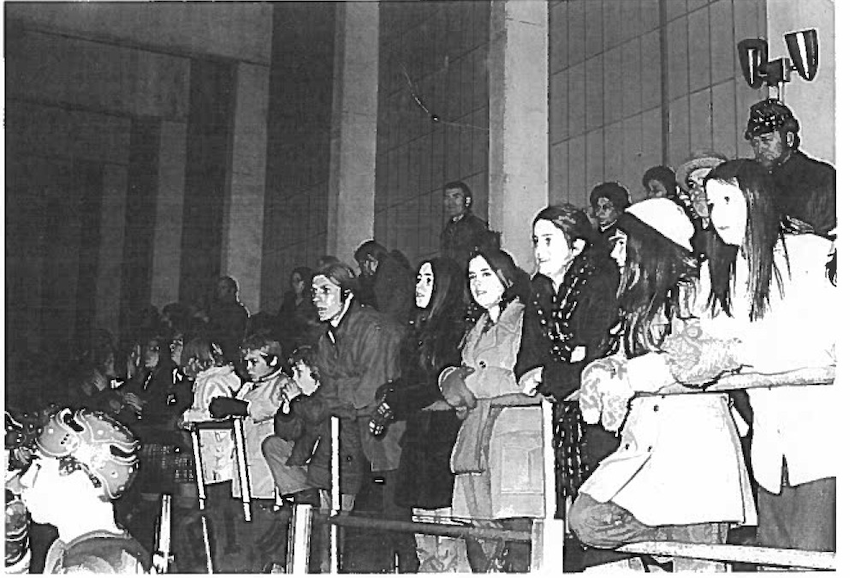
Watching a high school game (possibly 1972)

All my brothers were groomed from an early age to be ice hockey players, and I was groomed to be spectator par excellence. Mom and Dad imagined themselves, at least in the beginning, as devoted hockey parents. Mom, for her part, was always there when called upon to shout at the refs or rattle the cow bell when a goal was scored. Easy to spot in her red quilted “car coat” among the fans in the bleachers, she was a little woman with a big voice. She did not need the cow bell. My grandfather, whose world revolved around music, had only ever foreseen for his oldest daughter one application for all that training in voice, that careful development of the diaphragm, and it wasn’t to give full and honeyed expression to the soprano section of dedicated fans. It was to skewer the referee with comments like, “Hennessy, you’re a dink!”

In rinks all over the South Shore I watched my brothers on the ice, and I watched Mom watching them. As a teenager, I then expanded my spectating to include my younger brothers who began their training by pushing wooden boxes or kitchen chairs all over the ice. Organized youth hockey programs were just taking off in our region; their popularity quickly skyrocketed, propelling hordes of youngsters throughout my town to the area’s frozen bodies of water; there were several ponds and lakes — as one would expect in a town called Bridgewater — that provided great conditions for skating: Carver Pond, Skeeter Mill Pond, Sturtevant’s Corner, and the Ice Pond (aka State Farm Pond).  Unfortunately — but unsurprisingly — ice skating never struck me as especially fun; on those occasions when I did take to the ice myself, I would be the lone skater, trying over and over to perform a simple move such as stopping forward motion or resuming forward motion. . . artistically.  I never progressed, and as impressed as I was with Peggy Fleming, her moves just totally confounded me; how did she spin so fast and leap so high. . . all with such grace and beauty? I only knew it had something to do with physics. . . I think.

The 1960’s and 70’s were the sweet spot, I believe, for pick-up hockey games in which teams were naturally selected by blood ties.  The baby boom generation — lots of families with lots of kids — provided a ripe culture for casual team sports.  The Bruins’ success, too, in the early 70’s converted young spectators into NHL aspirants.  Although gear was optional, hockey gloves were one of the more prized pieces of equipment, given that rules of engagement were rather loose, and hands were constantly getting smashed.  It didn’t matter if they were mismatched, or had holes, or even fit properly; when two players squared off, as long as those gauntlets could be thrown down in a flash, they served their greatest purpose. On the other hand, a helmet, perhaps the most important appurtenance from a long-term health standpoint, was audaciously absent. Although randomly assembled teams were a perfectly suitable option, in many cases entire teams could be made up of a single family or a neighborhood combination of families.  Hence, there were rivalries that evolved rather organically; the Morrisseys and Maloneys, for example, nurtured a competitive relationship that regularly included family sponsored fighting.  Kevin, of course, in his typically zealous manner, nobly did his part for the Morrisseys.  As feared as he might have been by his foes, there was genuine admiration of his skill set, which extended even to ice surface management. Few kids, for example, would risk submerging their own vehicles in order to clear the ice of snow. As the shinny baton was later passed to younger brothers Marty and Bob, the family names changed; the Heslin brothers and the Blakelys brought greater finesse and skill to the pond hockey scene. At this point, kids could just generally boast a more expansive indoctrination. Organized hockey had truly arrived in Bridgewater.

Pick-up style hockey continued to enjoy popularity in subsequent decades, but, naturally, the game has experienced a metamorphosis. What we observe in the sport today is akin to a coming-of-age; rarely do we see genuine, improvised games on local ponds. It catches our eye when we do see a small clutch of kids with sticks in hand, movement back and forth between two makeshift goals on a suitably frozen pond. Even the length of the season has shortened; in earlier years it might have been possible, at least in coastal Massachusetts, to take to the ice in November; extended periods of cold are much rarer these days.  

Baby boomers never really left their passion behind, however. Pick-up games now more readily conjure ice rink settings, and schedules are firmly set, leaving one to wonder about the persistence of the name.  And if you live in cold winter states such as Minnesota or Colorado, outdoor pick-up tournaments, which draw thousands of participants and are often sponsored by big-name purveyors of beer, bring you that much closer to your unfulfilled dream of playing professionally. They’re highly organized programs, with perimeter boards and goalie nets that are the real deal, (one even boasts Zamboni service!), so prepare accordingly. Make sure you arrive with matching gloves, fashion forward attire and a mouthguard for your few remaining original teeth.  

As impressed as I am with the dedication and zeal displayed by players in the “well beyond their prime” age bracket, there is no other way to describe my own experiences on the ice than to say that they were fraught. My tenure as spectator — of the plein-air and local rink sort — provided more pleasurable memories, even if these days I now greatly prefer an experience that involves a large screen TV while sitting on a couch. . . with a cozy afghan. . .  and a beverage (cold or hot, it wouldn’t matter). My heart twists, though, whenever I inveigh against a controversial call by the ref; it’s as if I’ve been transported back to those state rinks throughout the South Shore, when several times in any given game my mom’s voice would boom across the ice, poetically goring an earnest ref whose only crime was wielding a whistle. Good memories, after all.

(This is a revision of a story that first appeared in my Scosche of Class Blog in March, 2019.)

Massachusetts Birders Flock to See the Rare Steller’s Sea Eagle

Imagine being lost for a year and a half, desperately trying to get back on the path to home, which might be as much as 4700 miles away. You try one direction and it lands you in Alaska, you try another, and you’re possibly in Texas, then Quebec, then Nova Scotia, then Massachusetts, specifically the lower Taunton River. You’re alone, the only one of your species; the best you can hope for to meet your social needs is a similar predator species, such as the bald eagle. 

Birders all over the country are hyperventilating over the random appearance of a Steller’s Sea Eagle, native to coastal China and eastern Russia, and considered one of the world’s largest raptors. It lost its way mid-2020 through what is called vagrancy. There are a couple of primary reasons why vagrancy occurs. Often, a bird will make a navigational error, which doesn’t inspire quite as much sympathy as the other reason why vagrancy occurs, that is, extreme weather. Scientists are happy to point out the upside of vagrancy, despite birds’ own wishes not to be affixed with the “vagrant” label. With natural habitats becoming altered through climate change, accidental transport sometimes allows for a species to test out a new territory.  

It saddens me that this one remarkable bird — to even see pictures of it inspires awe with its splendid markings and enormous wingspan — is so obviously and desperately trying to find the way home. . . alone. We’re all pulling for him (or her), hopeful that with all this crisscrossing of our continent, the right path will be stumbled upon (or flown onto). 

This is a great site, kept fresh and interesting by birdwatchers who report on bird sightings: https://ebird.org/species/stseag