As much as I know that this post should be limited to a sharing of information, such is the case these days that a tendency to editorialize will inevitably color it. I want to believe that I am capable of rising above the vitriol and general nonsense that emanates incessantly from the current White House Administration. Nevertheless, I ask, how insecure must you be to insist that at every public entry point into the Smithsonian’s National Museum of American History (NMAH) a warning will be affixed that alerts the public, “Warning: the exhibits in this museum were prepared by people who don’t want you to love your country”?
This pathetic and petty warning appears to be a distillation of the 162-page report prepared by the White House Domestic Policy Council (DPC) regarding the policies and programs of the Smithsonian Institution. Even the report’s title “Saving America’s Story: How Ideological Capture of the Smithsonian Institution’s National Museum of American History Erases Our Heritage” inspires the titillation of scandal that Mr. Orange Face just loves to provoke at every turn.
Have you ever visited the Smithsonian’s Museum of American History? For me, it was the highlight of our family’s trip to D.C. in 1987, back when we parents were still able to influence our children’s activities to any measurable degree. A little overwhelming given the enormity of its collection, but breathtaking, too, for the same reason. Because I wanted for my children to have enough of a context so that the exhibits really engaged their interest and curiosity, I spent a lot of time preparing notes that I hand-wrote on index cards. I needn’t have bothered with this exercise because—in the moment—I kept having to refer to my prepared remarks. Such was my shaky command of American history. (Also in that moment, I became the embarrassing mom. . . and wife.)
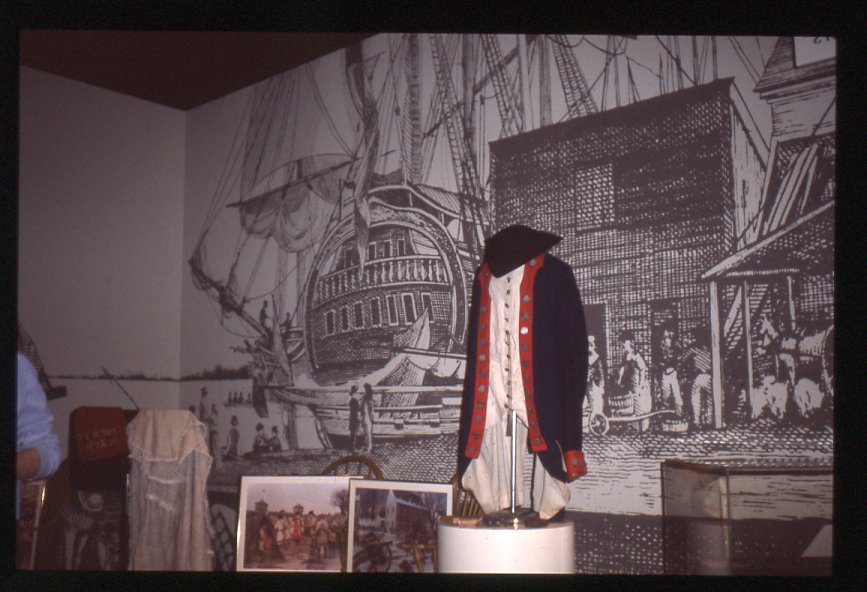
I had imagined that I, like any knowledgeable museum docent, would usher my rapt charges through the more popular exhibition spaces, pointing out fascinating details, such as this, delivered sotto voce as if to share a juicy bit of gossip: Did you know that First Lady Mamie Eisenhower’s pearls were fake? Without breaking stride or momentum, we would then move on to view Mr. Rogers’ unforgettable red cardigan, at which point I would reach for my chest with splayed hand and shake my head as I pointed out, So sad he couldn’t tell the difference between his red cardigan and his green one; all brown, of course, just different shades. Our beloved Mr. Rogers was colorblind. (Another fun fact: his mother made all his sweaters, installing zippers instead of buttons, so that her son could easily sing his song while putting on his sweater.) Our visit to Mr. Rogers’ cardigan would be followed by the ruby red slippers that Dorothy had clicked together—a tad uncertain—when the all-important lesson descended upon her that there’s no place like home. Anyone knows that Dorothy wore “ruby red” in the 1939 movie, but did you know that L. Frank Baum had described them as silver in his 1900 novel. I’ll leave you to puzzle out why the directors opted for red.*
Isn’t it astonishing that our woefully misguided president felt the need to squander his time and energies by writing and issuing an executive order aimed at “restoring truth and sanity to American history”? No one is against truth and sanity, of course, but the finer details of the mandate insisted that the vice president (in this case, J.D. Vance) eliminate “improper, divisive, or anti-American ideology” from the Smithsonian. Central to the aims of our president’s “Truth and Sanity” executive order is the desire to remove historical evidence of poor behavior. Let’s face it, though; our “shared inheritance” includes, in addition to extraordinary accomplishments, some pretty atrocious behavior, even immoral behavior, all manner of behavior that unmasks flawed systems of belief. We weren’t perfect. We’re not perfect now.
Is the inclusion in the Smithsonian’s “Many Voices, One Nation” exhibition of implements of bondage that reflect that long era of slavery too much for the delicate sensibilities of the white nationalists among us? In the 162-page report, whose release by the White House Domestic Policy Council was timed to coincide with our nation’s semiquincentennial, the DPC claims that the Smithsonian’s goal is “to instill within visitors its belief that migration and immigration, including the granting of citizenship to illegal aliens, is a defining modern-day civil rights and human liberty issue.” You’d have to have been living under a rock the last two years not to concede that citizenship and immigration are a defining modern-day civil rights and human liberty issue. (We could argue, too, that they have been for as long as we’ve been a nation). It’s hardly a criticism from which we should feel the need to recoil in disgust. It’s a modest wake-up call that suggests we can do better by the immigrants who arrive here, often in desperation, but buoyed by hope.
Descendants of immigrants should have no trouble conceptualizing that sense of hope that propelled their ancestors to America. It would have been the one element that sustained them through their journey to a destination whose precise details they often found impossible to conceive. The journey began, of course, with them hugging their loved ones—holding them tighter and a little bit longer—and saying goodbye. I wonder, did they believe their own promises to see them again? As I’m sure many descendants of immigrants do, I often try to imagine the contrasting cultures that our forebears experienced. For example, rural western Ireland tenancy life vs. mill city tenements and textile factories. However disparate those settings, America then and now were similar in their disparagement of immigrants.
The Pew Research Center offers interesting insight into recent patterns of immigration. (https://www.pewresearch.org/short-reads/2025/08/21/key-findings-about-us-immigrants/) Inasmuch as our nation has been shaped throughout our history by the arrival of immigrants from all corners of the earth (as much as 98% of our population can be categorized as immigrants or descendants of immigrants), our policies toward immigration have become more restrictive in recent years. It can be argued that they have always reflected an attitude of contempt born of suspicion and distrust (classic xenophobia). (Even President Biden enacted legislation that imposed stricter limits on asylum in 2024.) Under the current administration, we find that for the first time since the 1960’s the immigrant population has declined. (Pew)
The current Administration has been especially callous and cruel toward immigrants and other disenfranchised classes of people to the point whereby they hope not just to squelch constitutionally protected rights, but to silence and even erase marginalized groups who dare to exercise them (and even those individuals who don’t “create a fuss” because, why, they just look different or they have a foreign-sounding surname or they support the wrong people or causes. . . or whatever).
When one sanitizes our past—as the President’s Executive Order 12453 of March 27, 2025 mandates—it demeans our citizenry. Instead of expressing the fullness of our nation’s story, a romanticized and inauthentic narrative supplants it. The very thing that the executive order decries—the “replacing [of] objective facts with a distorted narrative driven by ideology rather than truth”—is systematically (and ironically) becoming our reality.
What would the Administration have visitors see at the NMAH (instead of the expertly curated exhibitions)? Evidence that portrays our founding fathers as perfect human beings? Wealthy plantation owners, but without the slaves? Photos of immigrants arriving from Western Europe, their faces aglow from hours and days spent lounging on open ship decks (instead of pressed uncomfortably together in cargo holds)? What about the lessons that the women’s suffrage movement can teach us? Does the Administration quail at the thought that “groups with limited political power” can effect real change through their right to vote and through public protest?
The President’s executive order took direct aim at the venerable Smithsonian Institution. (He has a habit of singling out prestigious, honored organizations that enjoy acclaim by the public. Another case in point: the John F. Kennedy Center for the Performing Arts.) It seems less about professed claims of “improper ideology” and more a consequence of an uneducated, petulant man whose stunted development provides no room for dissent, and whose ignorance about American history has him pitching a fit because not enough museum space has been dedicated to Christopher Columbus, the Pilgrims, and the vaunted glory of our founding fathers. (One can see here the extent of this president’s understanding of American history.) And, forget about the Smithsonian’s encouragement of critical thinking! That just leads to close examination and challenging questions. Yikes, we can’t have that!
I haven’t returned to the Smithsonian’s Museum of American History, but it remains on my list. The older me would want to see very different exhibits than those that the young mother in me singled out for her children’s educational benefit. (To begin, I would not want to miss Carl Yastrzemski’s batting helmet. That, and examples of tools used in bloodletting because I have a morbid curiosity about infectious diseases in the era before germ theory became accepted science.)
The entirety of the Smithsonian Institution as an educational and cultural treasure—with all 21 of its museums, galleries, libraries, and the Zoo, not to mention its research and education centers—is an invaluable treasure. It articulates our collective moments of achievement and allows us to pause, too, in reflection and inquiry in the face of our sobering, unenlightened moments, those that have caused us great shame. Reputable museums don’t overplay the lustrous aspects in a shallow bid to win our approval. That’s not what they’re all about. To present history in an authentic manner, they must also examine and offer evidence that sometimes counterbalances and other times countervails the burnished features of our past. The best museums, however, take it a step further; they don’t just present and explain artifacts, they stimulate a sense of wonder and inquiry. The viewer is guided to think, Why (or how) did this happen? What does it mean?
I’ve read parts of the DPC report “Saving America’s Story” and related summaries, and urge others to do so. The National Council on Public History (NCPH), just one among many historical organizations to condemn the report, considers it to be an “unserious and distorted document. . . [that] fails to reflect the basic and fundamental standards of scholarship, including an accurate interpretation of the full evidentiary record.”
The DPC report was prepared by non-historians who perhaps harbor their own myopic viewpoint of American history and who—at the very least—delivered to their president exactly the product he mandated, a sharp and dogmatic criticism of one of our most respected and cherished museums. I leave you with this question: How well do you trust this report about the Smithsonian’s National Museum of American History?
————————————
*With the introduction of technicolor in movies in the late 1930’s, it was felt, naturally, that red shoes would be more of a wow factor than silver. Well done, Noel Langley, screenwriter.
Sources:
PewResearchCenter.org: “What the data says about immigrants in the U.S.”, August 21, 2025″. Kramer, Stephanie and Passel, Jeffrey.
https://www.whitehouse.gov/wp-content/uploads/2026/07/Smithsonian-Report-Saving-Americas-Story.pdf
https://ncph.org/news/ncph-statement-in-response-to-white-house-saving-americas-story-report

