(“Standing at the Edge” appeared in November, 2021 on my old blog; it has been further edited and expanded.)
The series of aerial photos was of a property all too familiar. Seen “bird’s eye”, one might feel compelled to view the images dispassionately, but my emotions played some tricks on me. Nostalgia made me smile; regret made me sigh.
In the mid 1980’s, Mom, Uncle Bob, and Aunt Marie bought a small house on a small lot high on Manomet Bluffs on the southeast coast of Massachusetts, technically not quite a part of Cape Cod, but close enough to feel a sturdy kinship. When you have expansive, breathtaking views of all of Cape Cod Bay, you shrug at the smallness of your staging ground. In any season, on any day — or night — a seascape can be called forth just by wishing it, just by facing east.
While I can’t be 100% sure about Uncle Bob and Aunt Marie, I have no doubts that this little house was the one that Mom loved best. Inasmuch as every memory I have of Mom from that brief period in time presents someone who had found her deserved happiness, the photos I held in my hand were disturbing reminders — the tangible evidence — that their little house on the bluff (affectionately — and always with droll effect — called “Blind Man’s Bluff” because Uncle Bob was blind) was at great risk of tumbling into the sea. I shuffled the glossy photos one final time, lined them up neatly by smacking their lower edges on the table a couple times. I intended to put them away once more, but the decision to save them, I realized, was no decision at all, just kickin’ the can down the road. I instead went over to the trash barrel and tossed them all in, taking a moment to absorb what I was doing. Everyone knows how I hold onto the past. However, because I knew precisely why the aerial set of photos had been ordered in the first place, keeping them was a form of punishment.
The three siblings kept up the gambit for seven years, preferring to count their blessings. One of the first things they had done upon arrival was plant a tripod — with great ceremony — in the middle of the second floor living room; upon the stand they secured a telescope that faced the wall of windows, drawing toward their eye all the activity taking place directly east of them in Cape Cod Bay. One could not climb the open spiral staircase and enter the living room without responding to the beckoning telescope’s eyepiece. On more days than not, they had a clear view straight across to Provincetown, at the very tip of Cape Cod.
Each season offered a bounty of stimulating activities. Even when winter’s furious gales pinned the crag clingers inside their home, their curiosity about life on the Bay continued unabated. And each time air temperatures and weather patterns signaled seasonal change, the activity in, on, and around the water adjusted accordingly.
With an abiding love of learning, the two sisters and one brother quickly taught themselves the habits of various marine birds, but they were especially interested in the great variety of fish species with which the Bay teemed — striped bass, bluefish (who always put on a spectacular display for those who closely monitored fishing activity,) mackerel, pollock, and — of course — cod. (The namesake species, however, was already in decline by then due to decades of over-fishing.) Whales, too, would occasionally wander into the Bay, getting slightly mixed up on their seasonal migration. Sometimes, they were simply in hot pursuit of prey further down the food chain who had lost their own way.
“Aha! You were right, Bob,” one or the other of the sisters would narrate as she leaned into the eyepiece, “Lucky Striker’s back. . . with his arm in a sling. Looks like he might have a deckhand today. Son, maybe?” Each chapter built on the one before, and it wasn’t long before they had fully imagined characters, backstories, and conflicts. By making it a daily habit, they came to know — in their own way — the regulars who plied the waters. Never knowing their real names, they nevertheless could identify them by their boats, and their habits. They could tell you, for example, exactly which lobster pot would be pulled next, and the next one after that. They knew which lobstermen took their time and which ones worked in a hurry, who was absent. . . and for how long. Because sound traveled whole and unimpeded up the face of the bluff, they could, as well, categorize the fishermen by their musical preferences. By and large solitary figures absorbed in their own endeavors, on occasion one captain might motor over to another to engage briefly in conversation. It wasn’t social; topics appeared serious. New industry regulations, perhaps?
The three cliff-dwellers followed with even greater interest the illegal drug smuggling operations, which were often interrupted by U.S. Customs or Coast Guard busts. On occasion, the aerial surveillance by helicopter and high-speed pursuits over water provided exciting entertainment. (Law enforcement was very busy in the waters of Cape Cod all through the 1980’s, first with their efforts to stanch the flow of Mexican marijuana into our country, and later with the Colombian cocaine trade.)
I was recently told that the little house on Manomet Bluffs sits at the highest elevation in Plymouth County. It feels as if it could be true when you arrive there by automobile — steadily ascending the narrow shore road to its highest point. And it looks like it could be true if you’re out in the bay and you scan the coastline. Low growing trees — scrub pine, mainly — and lots of laurel line the undulating horizon. It’s not that high, for the record. (The highest elevation in the county is a short 4 miles inland.) “Indian Hill”, the particular summit on Manomet Bluffs to which the house is moored, shows on topographical maps as being 161’ above sea level; it is still impressively high up there, and gives you a heady experience when you stand at the edge and allow your eyes to abruptly travel down the sheer, mostly sandy face of the bluff.
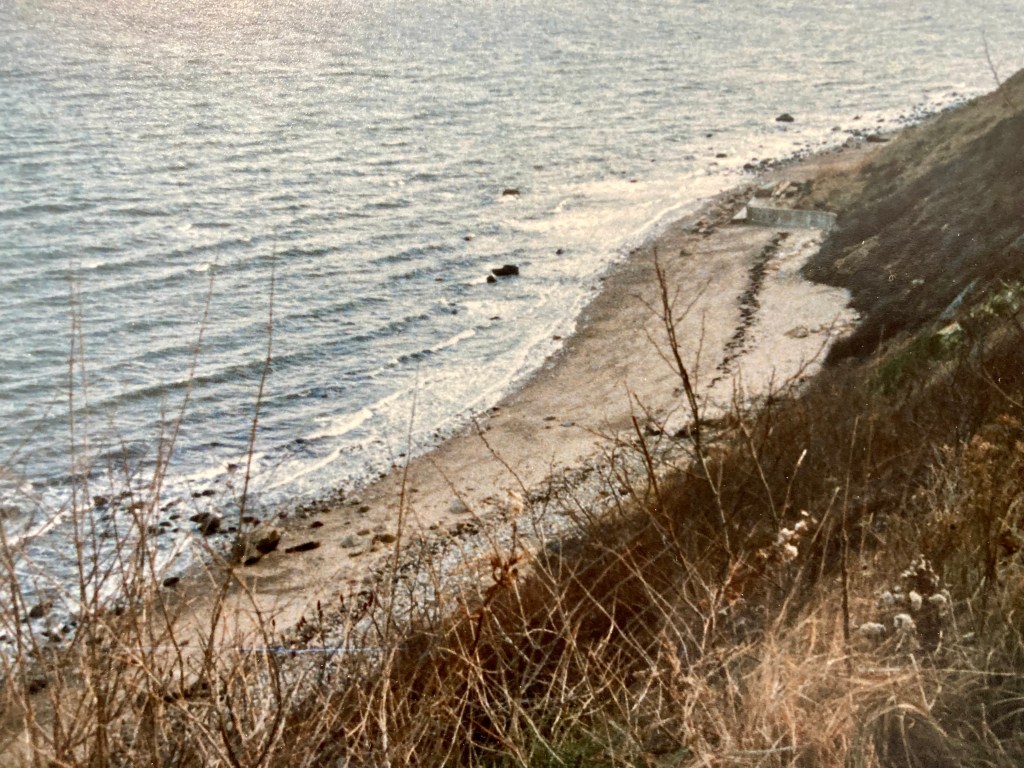
Follow the shoreline road directly south, and you descend toward sea level and the entry point to the beach. If it can be said that the dramatic, panoramic views from above encouraged big picture thinking, the beach below, in the lee of the bluff, offered an essential counterpoint; it allowed for close scrutiny. All activity at that level was hands-on; it was important to be able to hold things, turn them this way and that, feel all the contours and textures. And wonder about it, talk about it. Any visitor to Blind Man’s Bluff was entertained by a new story about a recently discovered treasure — what it was, where it was found, how they’d determined its keepsake value. The home thus became a vibrant museum with an ever-changing gallery of found marine treasures.
As much as they loved that perch with its stunning views of the bay; where the ocean air was never still; where their daily ministrations were accompanied by the syncopated strains of sea gull squawks, fog horns, and the low vibrations of boat motors; and where they could cheerfully practice their “5:00 somewhere” (or was it 4:00?) outlook on life; they knew it was only a matter of time before their back yard collapsed into the Atlantic. In the back of their minds, they must have known that their small-scale measures — ecologically sound as they might have been — were inadequate; the salubrious, composted slurry that they mixed up daily in their kitchen and cast over the edge of the bluff was no doubt seasoned with a fervent sense of wishful thinking, maybe even swathed in a wry prayer to the Blessed Virgin Mary. It’s not hard to imagine them examining closely, but with diminishing hope, for signs that their vegetable concoction had taken literal hold of the unstable bluff. After exhausting the ordinary slate of homeowner remedies designed to arrest the advance of the ocean (in your desperation irrationality can be forgiven), with hearts heavy but minds clear, they sold their little piece of heaven.
~
I live ninety miles north of Manomet Bluffs, also on the coast, but, because I’m an especially cautious person — and a worrier — not right on the water. Several times a week (particularly in the off-season) I take my dogs to Salisbury Beach State Reservation, two miles away. When the cold weather creeps into our region, usually by the end of October, I have a selfish expectation that “The Rez” will — as ever — revert to the quiet sanctuary that encourages private thought and a solitary appreciation of its natural gifts. One lap around the empty campground with a slight detour out to the boat launch where Black Rock Creek meets the Merrimack River gives me just enough time to rearrange my scattered thoughts, and, of course, set my world to rights once more. My two dogs, likewise, lean into the activity, responding to the invigorating qualities of The Rez. They’re eager (more so than I) to sprint along the seawall and cavort at river’s edge, maybe even lap at the briny water (which, of course, they’ll promptly throw up). The further away from the parking lot we move, the more immersed we become in our own pursuits.
So, on one particular morning, I almost don’t notice the low grumbling sound from across the river. Looking over to Plum Island on the opposite bank of the Merrimack, I can just make out the bobbing motion of a large piece of machinery as it excavates sand. Large excavators on a barrier beach attract a fair amount of attention, attention that often billows in clouds of controversy. Right now, a handful of dark figures stands motionless at the edge of the dune; no doubt, islanders filled with equal measures of curiosity and apprehension, apprehension being a sentiment they find impossible to shake these days. For people with homes either directly on the ocean or at the mouth of the Merrimack River (Plum Island, like Salisbury Beach, sits at the very confluence of the Atlantic Ocean and the Merrimack River), weather forecasts are tidings to be followed closely and parsed, their sources carefully vetted.
The Merrimack River is always spoken of in terms of its ability to bounce back from adversity, the “Resilient Merrimack”, it’s often called. Surging, cascading, and gliding along its 117-mile course, it supplies over half a million people with drinking water, all the way up into central New Hampshire. Many of the cities throughout the Merrimack Valley, in fact, owe their very existence to this river. Follow the river inland and you pass through Haverhill, Lawrence, Lowell, on into New Hampshire and cities such as Nashua, Manchester, Hooksett, Concord, Franklin. None of these cities would have endured without the empowering waters of the Merrimack.
As I’m squinting to see what’s happening on Plum Island, I remember that the meteorologists warned of a one-two punch with astronomically high tides and a storm well out to sea, but still near enough to menace the coast. Curious, I steer the dogs back the other way toward the beach on the ocean side, but before I’ve rounded the first dune, I already notice how the familiar contours of the sand near the tall north jetty have been altered. This happens regularly, however; aggressive tidal action shifts the sand wildly, sometimes completely covering the jetty, only to move it back to its original place after a few more tides. When I pass the dune with my two dogs, I’m brought up short by the scene before me — lobster traps and buoys, giant mounds of rockweed, random lumps of wood, and even an orange traffic cone and a 5-gallon plastic bucket litter the sand. Looking north along the length of the beach, I consider that all the debris ranging out in front of me is an amalgamation of things that were ripped from the shore and others that were hurled at it, all comingling and implying a savagery that unnerves. And this one wasn’t even a direct hit. Deep gouges have been carved by the punishing waves. In both the near distance and far, I see stairways — the fragile threads that connect homes with their coveted spots on the beach — dangling well above the sand. And along that same ribbon of churned sand, a different set of dark figures surveys the damage.
None of this suggests a new pattern, it should be noted. Almost forty years ago, and ninety miles south of here, my mom and her two siblings were watching with a similar sense of foreboding as each storm pummeled their segment of the coast. And just like then, it serves to underscore that Mother Nature enjoys a lopsided advantage in her enduring battle with mankind.
When you fall in love with the place you adopt as your home, whether that be on the ocean or a river or nestled deep in a glacial valley surrounded by gentle hills, you pay attention to physical changes. . . and you worry, or at least you should worry. Inasmuch as we’d like to rely on our planet’s adaptability, by continuing to invoke divine intervention (and if not that, then the ministrations of local, state, and even federal government), we fail to perceive the “use by” date; in other words, we risk everything by failing to heed environmental warnings. As that series of aerial photos of Manomet Bluffs made so clear, it’s sometimes too painful, too upsetting, too real to pull back and see the big picture. Just one more roll of the die, you say as you blow on the pair and then uncurl your fingers, almost too afraid to watch as the cubes rock on their edges and settle into place.
In October of 2020, Plum Island homeowners on the north end of the island coordinated an effort to establish a barricade using one-ton “Super Sacks”, enormous plastic bags filled with sand. It ended badly for them. If you’ve never before seen one of these Super Sacks, up close it is reassuringly enormous, and that’s just one. Imagine hundreds stacked shoulder to shoulder, an entrenched defensive army bracing against a formidable adversary, one whose tactics are not easily discerned. Less than a year later, the bags had been shredded, and the ocean — as if exacting bounty — reclaimed its sand. It was hard for Plum Islanders not to notice Poseidon’s hand in all of it; he has a way of making his point about man’s puniness.
Plum Island homeowners, I learned, in yet another effort to disrupt the sustained assault by the ocean, obtained a consequential legal dispensation that they hope, once again, will buy time until a more permanent solution rescues them from this never-ending crisis. Maybe those dark figures separated from me by a narrow band of water are bowing their heads in silent supplication as the big equipment erects a new barrier. The current scheme utilizes giant rocks and stitched-together coir bags, immobilized by wood pilings driven deep into the sand. The wood pilings, in particular, get me to thinking. After seeing past efforts fail, is there greater confidence that by digging deeper into the ground, the ocean will be vanquished? And, how deep is deep enough to be able to get a firm grip on what each is hoping to hold onto?
As someone who has lived on the Atlantic coast for nearly five decades, it is impossible to ignore the effects of global warming and consequent sea level rise, and with that, soil erosion. I started to pay closer attention, in particular, as more and more investigative reports focused on Greenland’s dramatic ice sheet melt. I was puzzled, initially. In what way does the accelerated melt have to do with the Gulf of Maine’s waters or the shift in the Gulf Stream? Why was — and is — that so important to all of us who live on the coast of Massachusetts? It seems important to make the complex connection between that ongoing event and the changes that I’ve been noting on my dog walks.
One can easily get lost in the seemingly endless chain of cause and effect. Did it all start with the industrial era? Or even earlier? If later, the weight of our own behaviors, and the decisions and choices that we have made could drag us under as we shift the narrative to one of culpability. Ah, if only we could continue to shrug it off as a temporary (but entirely fixable) ecosystem imbalance. It’s inevitable, we might even say; it will right itself over time. My restive spirit strains to see the ultimate good that can be achieved through either complacency or — worse — makeshift (and myopic) remedies that at best provide transitory relief.
I perceive the escalation of despair among those most directly affected by coastal erosion, and am sympathetic to their urgent pleas for deliverance. With each storm that sweeps through, the force that the homeowners use to press their palms together in impassioned appeal increases; their anguish spreads deeper. A good many of them are third and fourth generation homeowners of cottages that have long ceased to be merely seasonal. How hard it must be for them to imagine forfeiture, both of a lifestyle and a family’s legacy. It is not for me to pass judgment on beach homeowners’ determination to save their property. If I lived eye-to-eye with the ocean, I would want to do the same.
To everyone’s surprise, Manomet Bluffs and the little house that roosts at its edge, keeping a wary eye on storms that swoop across Cape Cod Bay, continue to stand sentinel at the retreating margin of our east coast. While stoically resisting the relentless pounding of the Atlantic Ocean, the escarpment is ever so gradually surrendering its tenuous grasp. . . one delicate clump of soil at a time. There is no denying, however that vegetation still stubbornly clings to the unstable surface. It makes one wonder if that composted admixture being poured from above decades earlier did work some magic after all. It’s very mystifying; we can’t make sense of it. With no promising sign that the current trend of coastal erosion will reverse itself (in fact, the data make abundantly clear that ocean storms are becoming more intense and more frequent, and that sea levels are steadily rising at an ever-increasing rate); we nevertheless see it as a reminder of nature’s fighting spirit, its persistent quest to self-heal. It gives us hope.
There’s no easy answer, no easy fix, and it’s quite possible that at some point in our lives, we will all find ourselves standing at the edge of a cliff. Teetering thus, we might — even unwittingly — concede the pragmatic value of the long view. Maybe it’ll be the only one that helps make sense of it all, given that “it” varies from one person to the next. By making periodic small adjustments to the telescope’s lens, we keep the horizon always in focus, accordingly opening ourselves to more promising prospects and ultimately a deeper understanding of nature’s plan and where we stand — and where we hope to stand — in relationship to it.
EPILOGUE
My late husband always traveled with a pair of binoculars in his car. Even without them, he was a keen observer of the landscape. After he passed away, I made a new carrying case for the binoculars, and placed them within easy reach in my own car. What I soon discovered was that I was viewing my surroundings differently. Instead of being drawn to disparate elements, my eyes began to seek the horizon and the defining margins of the diverse landscapes. Open fields; gently rising hills; wide meadows; long, flat stretches of marshland; and, of course, every body of water — their vast size and beauty held a jumble of earnest flora and fauna and all the sacred secrets of life, detectable only by raising the binoculars to my eyes. It affirmed for me the mysterious and magnificent design of the natural world, with all its harmonious parts.

My best and humble advice, therefore, is to invest in a decent pair of binoculars and keep them near you wherever you travel. It is always in an unexpected and thrilling instant that they come in handy, as happened to me only yesterday when I spied a bald eagle traveling south above the saltmarsh. En route to its deep winter fishing ground close to the mouth of the Merrimack, it flew right above me. Although it seemed not to have noticed my presence, nor — more importantly — potential quarry in the form of two small dogs, I was confident that long before I had caught sight of him, he had already sized up the situation. For me, the sight was reassuring, as it always is, for it reminded me that there are still parts of nature that perform in the expected ways. Tracing the path of the majestic bird with my binoculars as it veered west to head upriver, I was filled with gratitude, my mind at peace.
And I get it now, why people cling fiercely and stubbornly, even desperately to a piece of unstable earth. It may be an epic provocation of Poseidon or other gods and goddesses of nature, and/or a wild and audacious calculation of risk and reward, but when I reflect back on my mom’s seven-year experience living on a high bluff at the fragile edge of our continent, I realize that each of us defines our own life expectations — our aspirations and our personal limits. We make our own calculations of risk and reward, and live according to those terms. For seven very full years, my mom and her siblings wove together a tapestry of rich experiences, ones that could fuel vivid, life-affirming memories. Who can say why some of us feel more strongly the siren call to the sea? There’s a clear difference between someone who lives right there — and craves an intimate connection — and someone like me, who can breathe in the sweet/salty, intoxicating sea air, but then walk away. . . my needs thus slaked.
So, why only seven years? It can be imagined that every beachfront property owner whose home and acreage are threatened by erosion worries about the next big storm. When you reach a tipping point, when your anxiety becomes unendurable and clarity of mind brings acceptance that no amount of composted slurry will cement that dissolving bluff, it’s time to draw the curtain. The house on Manomet Bluff was never intended to be the “forever” home anyway, at least for my mom. It was more a very long-term vacation home or an experiment in risky real estate. What the three siblings agreed on was that they never wanted to be in a position of coerced surrender, whether through managed retreat regulations or — God forbid — a massive collapse of their section of the bluff.
In the end, they walked away with an overflowing chest of exciting memories. There was no regret, even though the next home that Mom and Aunt Marie bought together was an unfussy, modest cottage in Yarmouth. Midway between Sagamore Bridge and the Cape’s “elbow”, their new home stood in a tidy, safe neighborhood where there was predictability and a tranquil sameness to their days. As Mom explained it to me in an end-of-summer card, back in 1993; “we certainly love living here. It’s a world of different considerations — all of them better except that view.” For the rest of their lives, one or the other sister would on occasion abruptly pause in whatever activity she was engaged in. The sewing machine would cease its rhythmic hum, the paintbrush would hover short of the canvas, the scrit-scrit of the trowel would become silenced in the soil as one sister would be conveyed by remembrance to Manomet Bluffs. With a far-away look on her face, she’d muse, “Oh, but that view!” And the other sister, with that same far-away look, would respond, “Mmm, that view!” In the comfortable silence that ensued, they were each turning over a remembered moment from that earlier time.


 JT McKenna Writes